Login

Login
Feb. 14, 2025
As the automobile industry in China rapidly advances, the country has emerged as the world’s second-largest tire producer, generating over 112 million waste tires each year, equivalent to approximately 3.2 million tons. This figure is escalating at a double-digit growth rate annually. The increasingly serious issue of "black pollution" has further deteriorated our already fragile ecological environment. The introduction of waste tire rubber powder equipment is vital for both environmental protection and resource utilization in the country.
The emergence of waste tire recycling equipment, which crushes waste tires, indicates that the persistent "black pollution" can now be efficiently managed and rectified. This tire rubber powder equipment aligns with the nation's call for the rational and green development of an eco-friendly economy, effectively achieving the concept of “turning waste into treasure” and significantly contributing to environmental conservation and resource utilization efforts.
In today’s fast-paced market economy, industrial growth remains a cornerstone of development. The green and eco-friendly utilization of waste tires is a pivotal direction for future economic advancement. Recent governmental policies underscore the strict environmental regulations and support for the recycling of waste resources, indicating that environmental protection and waste resource reclamation will be paramount in guiding our national development strategies. The waste tire recycling equipment specifically aims to convert waste tires into rubber powder, thus promoting a sustainable eco-friendly approach.
While many see the bright prospects of the rubber powder recycling industry, knowledge about the necessary equipment and processes for producing rubber powder remains limited. The market is saturated with various manufacturers that may not meet quality standards, which can hinder market growth. Consequently, it is crucial to research the waste tire rubber powder projects thoroughly and avoid impulsive investments.
When planning a project to recycle waste tires for rubber powder production, it is essential to grasp every aspect of the manufacturing process. This includes understanding the current market prices and availability of waste tires, identifying the manufacturers of waste tire recycling equipment, and comparing the costs associated with different suppliers. Lastly, ensure that there are effective sales channels for the resulting rubber particles. Resolving these considerations will provide a comprehensive understanding of the waste rubber recycling market and facilitate a targeted investment strategy.
China is a country with a substantial rubber demand. Currently, domestic production of natural and synthetic rubber can only satisfy about 25% of this demand, necessitating considerable imports. As both the rubber and automotive industries in China expand, the volume of waste tires and rubber products increases proportionately. Statistics reveal that the annual scrap volume of tires in China is at least 3.5 million tons, with a yearly growth rate of 10%. A large portion of this waste is not being effectively utilized, resulting in significant resource wastage and environmental concerns. Therefore, the challenge of recycling rubber is becoming increasingly pressing.
In recent years, the industry focused on processing waste rubber into particles and recycled rubber has been thriving. These materials are now widely utilized in various sectors, including tire manufacturing, plastic runways, waterproof membranes, and conveyor belts. By incorporating rubber powder or recycled rubber back into natural rubber (with usage in some products reaching 50%), the performance of rubber products—such as fatigue resistance—can be significantly enhanced. For instance, international practices show that integrating 20% fine rubber powder into tire products can considerably improve wear resistance and extend tire lifespans.
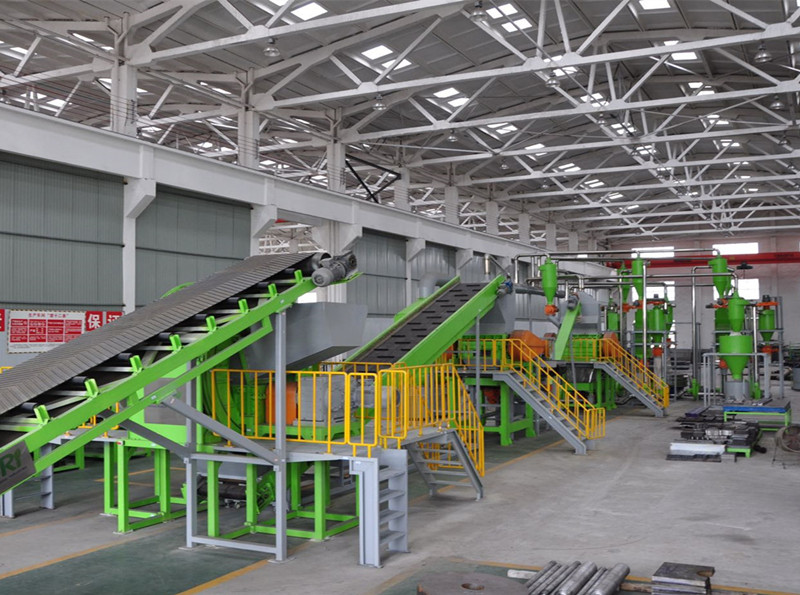
Waste tire recycling equipment transforms discarded rubber into valuable resources, enhancing the comprehensive utilization of rubber materials. For instance, shredded waste rubber can be repurposed into playground surfaces or rubber flooring. Understanding the structural composition of a complete waste tire recycling production line is crucial:
The waste tire recycling equipment is designed to process discarded tires and rubber into small rubber particles, simultaneously extracting three key materials: rubber, steel wire, and fiber.
The production line typically comprises a tire wire drawing machine, tire cutting machine, tire shredder, steel wire separator, rubber particle machine, fiber separator, and tire grinder.
It is important to note that different manufacturers may have varying requirements for the specifications and fineness of the rubber crushing process. Thus, conducting thorough investigations before purchasing is essential, and you should finalize decisions based on specific needs. For unique requirements, open communication with manufacturers can lead to further customization and design of waste tire recycling equipment.
133 0 0
Previous: None
Next: None
Join Us


Comments
All Comments ( 0 )